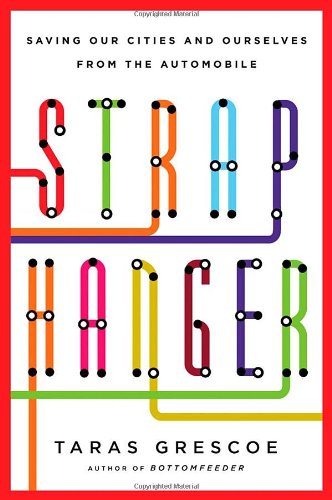
"Tracks stitch places together; freeways tear them apart" - Straphanger
From Bogota to Portland, Vancouver to Moscow, cities with urban transport systems you'd expect to find highlighted by a transit buff are explored on a personal adventure by author Taras Grescoe. Even cities you'd never expect to be featured (Philadelphia) are analyzed as experienced first-hand by Grescoe as he frames up a solid theory of how to save civilization from the supposed greatest evidence of progress from the 20th century--the automobile.
Grescoe's writing style is quite approachable and unpretentious even while he doesn't hesitate to pick sides on hotly debated topics. When there is an alternative opinion, such as a real estate developer in Portland pushing for making their transit system 'self-sustaining', he captures it wholly intact and acknowledges potential for legitimacy. He confidently lets the facts speak for themselves and trusts the reader to sort through which theories are suspect.
This book is important as it helps us understand what makes cities healthy and desirable, transit being only a portion of the equation. He also highlights cities that have screwed up terribly such as New York, which until recently hadn't built a single subway line in one hundred years. We learn that crime is growing quickly in the burbs while declining rapidly in city centers. We learn of the 24,000 annual deaths in California stem from particulate matter sputtered out of tailpipes, from break dusts, and tire rubber--a number six times greater than those killed from car accidents themselves. So-called cancer corridors span a mile on each side of freeways and are responsible for hardening of arteries, premature births, and life-long lung damage in children. Grescoe reminds us of a time when Los Angles sported a massive network of streetcar lines, affectionately referred to as Red Cars. At its height in 1926, for just a nickel one could travel over 1500 miles of track spanning four counties at up to 60 miles per hour. In fact, we can relive the story by watching the 1988 film Who Framed Roger Rabbit which showcases the Red Cars and their ultimate demise by being paved over with 'progress'. Nothing lasts forever. In later chapters, we look at just how much subsidies highways really receive.
The U.S. Office of Technology Assessment estimates the total public subsidies to automobile and truck users, including road maintenance, traffic regulation, and free parking, are at least $ 447 billion a year, and could be as high as $ 899 billion a year. The renowned transportation scholar Vukan Vuchic estimates that motorists pay only 60 percent of the total cost of their highway travel; the remaining 40 percent is subsidized by various levels of government. In other words, freeways are almost exactly as reliant on public subsidies as big-city transit systems (Grescoe, p. 241).
There is one section worth highlighting in detail: Grescoe's historical overview of the suburb, broken down into four version. Version 1.0 began as far back as 1853 in New Jersey's Llewellyn Park and in 1875 the Olmstead brothers' Riverside in Chicago. These pre-war neighborhoods were built with the wealthy in mind then and remain highly sought after even today. Bungalows in grids or streets with tight row homes offered convenient street car rides to urban centers and a variety of shops conveniently situated nearby. All of this changed in Suburbia 2.0 after World War 2 when six million families faced shared housing. A rapid assembly line approach couldn't deliver relief fast enough as tracks of 750 square foot houses sprang up on the fringes of cities across America. Here the Federal Government began incentivizing new home purchases by making mortgage interest tax-deductible making it cheaper to buy than rent. With incentives came the need to control just who exactly would prosper:
Researchers have found that maps drawn up by the Federal Housing Administration (created in 1934) surrounded African American, Asian, and Jewish neighborhoods in red ink, indicating the urban areas where mortgages would not be insured . Just as millions of rural blacks were arriving in Detroit, Chicago , Los Angeles, and other big cities, they were cut off from homeownership by the simplest of expedients: banks refused to give them loans. Without money to improve properties in redlined districts, city dwellers found their once stable neighborhoods succumbing to “blight”—further encouraging the flight to such all-white subdivisions as Levittown. (Grescoe, p. 92)
Grescoe compares the US response post-war to that of France and England where subsidized housing helped keep many european cities alive instead of suffer abandonment. He explains why the Federal Government supported a move towards suburbia over the density of a central city. During a six-year period, there was the belief that decentralization was a defense against nuclear attack and that an interstate freeway system could offer evacuation routes. By the time they realized that nuclear fallout could be carried great distances after the Bikini Atoll blast of 1954, it was too late to stop the momentum. To my surprise, Frank Lloyd Wright was a proponent of this thinking and he embraced the automobile and developed plans for Broadacre City.
Suburbia 3.0 drew jobs out to center-less masses of office parks with the brief advent of the Edge City. The price of oil quadrupled between the 1970's and 2000's and thus many of the more than 200 examples of edge cities started seeing a decline as downtown areas started experiencing a revival. Version 4.0 is the least appealing of the periods with the motive to leave the city becoming lack of affordability. This mean the elderly, immigrants and ethnic minorities are disproportionately moving into once highly desirable subdivisions because that's the only housing option left.
Of course, the biggest boondoggle of all is the one suburbanites most take for granted, and without which suburbia would wither and die: the federally funded freeway system, which, even as it beggared railroads and public transport, came to represent the greatest public subsidy to private real estate in the history of the world (Grescoe, p. 96).
Definitely, if you're a transit buff, urbanite, or simply appalled by the amount of time wasted sitting in isolation on congested freeways, this book will satisfy.
References
Grescoe, Taras (2012-04-24). Straphanger: Saving Our Cities and Ourselves from the Automobile (p. 92). Henry Holt and Co.. Kindle Edition.